In the booming digital economy, creators are often faced with a critical decision: Should I write an ebook or build an online course? Both are powerhouse assets for generating passive income, but the revenue potential and business models vary significantly.
If you are wondering about selling ebooks vs courses and which path will lead to higher profits for your brand, this guide breaks down the data, effort, and income potential for both.
High-Ticket vs. Low-Ticket
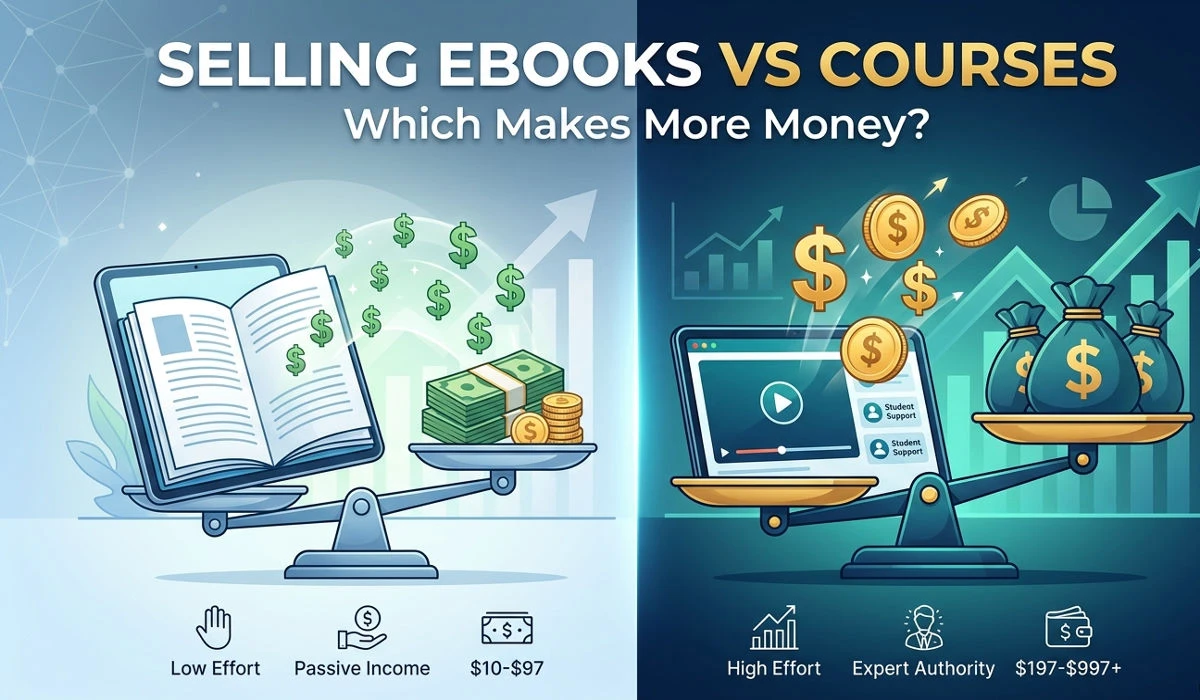
The most immediate difference when comparing selling ebooks vs courses is the price point.
- Ebooks: Generally priced between $10 and $97. They are “impulse buys” that require less trust from the customer.
- Courses: Can range from $197 to $2,000+.
Because courses offer video content, community access, and structured milestones, users perceive them as high-value transformations. If your goal is to hit a $5,000 monthly target, you’d need to sell hundreds of ebooks but only a handful of courses.
Production Time and Effort
When evaluating selling ebooks vs courses, you must consider the “time-to-market.”
- Ebooks: You can write, design, and launch an ebook in a matter of weeks. It requires no specialized equipment—just a word processor and a design tool like Canva.
- Courses: These require scriptwriting, video recording, professional lighting, and hosting platforms (like Teachable or Kajabi). The production cycle is often months long.
Passive Income vs. Active Support
Ebooks are the ultimate “set it and forget it” product. Once published, they require almost zero maintenance. In contrast, high-earning courses often require “active” elements like weekly Q&A sessions, student support, or community management to justify the high price tag. When selling ebooks vs courses, ebooks win on pure passivity, while courses win on total revenue.
Scalability and Customer Acquisition
Ebooks act as an incredible “Lead Magnet.” Because the entry price is low, it is easier to acquire a new customer. Many successful creators use the “Product Ladder” strategy: they sell an ebook first to build trust and then “upsell” those same customers into a high-priced course. In the battle of selling ebooks vs courses, using both in a funnel is often the most profitable move.
Market Trends and Consumer Behavior in 2026
In the current digital landscape of 2026, the eLearning market has shifted significantly toward high-impact, results-driven content. While ebooks remain a staple for quick information consumption, online courses are experiencing a massive surge due to the rise of “Micro-learning” and interactive education. Modern consumers are increasingly willing to pay a premium not just for information, but for a structured “transformation” that includes video demonstrations, community support, and direct access to an expert. This trend makes selling ebooks vs courses a matter of choosing between volume and value; while ebooks offer steady, low-friction sales, courses tap into the multi-billion dollar trend of skill-based certification, providing a much higher revenue ceiling for creators who can offer a comprehensive learning experience.
Customer Retention and Lifetime Value (LTV)
When analyzing selling ebooks vs courses, you must consider the lifetime value of your customers. A person who buys a $20 ebook may never interact with your brand again. However, a student who invests in a $500 course is much more likely to become a loyal advocate for your business. Courses allow you to build deeper relationships, leading to higher retention rates and the opportunity to sell future high-ticket coaching or consulting services.
Low Barrier to Entry vs. High Authority
The barrier to entry for selling ebooks is incredibly low, which means the competition is fierce. Almost anyone can publish a PDF. On the other hand, creating a professional video course establishes you as a dominant authority in your niche. The “perceived expertise” required to launch a course acts as a natural filter, reducing competition and allowing you to position your brand as a premium leader in the market.
Updates and Content Longevity
Digital products need to stay relevant, especially in fast-moving industries like tech or marketing. Ebooks are easier to update—you simply edit the text and re-upload the PDF. Courses, however, require re-recording video lessons, which can be time-consuming. When deciding between selling ebooks vs courses, consider how often your topic changes. If the information is “evergreen,” a course is a fantastic long-term investment; if it changes monthly, an ebook might be more manageable.
Refund Rates and Customer Satisfaction
Financially, refund rates play a huge role in your net profit. Ebooks typically have very low refund rates because the price is negligible for most buyers. Courses, due to their high cost, often attract more scrutiny. If a course doesn’t meet a student’s high expectations, they are more likely to request their money back. To maximize profit when selling ebooks vs courses, your course must deliver exceptional value to justify the higher price and keep refund rates low.
Which Makes More Money?
If you are looking for the highest total revenue, Online Courses are the clear winner. The ability to charge 10x to 50x more than an ebook allows for a much higher ceiling.
However, if you are a beginner with a small audience, Selling Ebooks is the safer and faster way to start making money. The most successful creators eventually do both—starting with an ebook to validate the idea and then expanding it into a full-scale video course.
FAQ
1. Is it harder to sell a $500 course than a $20 ebook?
Yes, it requires more marketing and “Social Proof.” However, because you need fewer customers to hit your income goals, your total marketing effort might actually be lower for a course in the long run.
2. Can I turn my ebook into a course later?
Absolutely! This is a top-tier strategy. Use your ebook chapters as the curriculum for your video modules. This ensures your course content is already proven to be what people want.
3. Which has lower refund rates?
Ebooks generally have lower refund rates because the investment is small. Courses, due to their high price, often see more refund requests if the student feels the “transformation” wasn’t achieved.
read more: Trending Digital Products That Are Selling Fast in 2026
How to Promote Digital Products Without Paid Ads in 2026