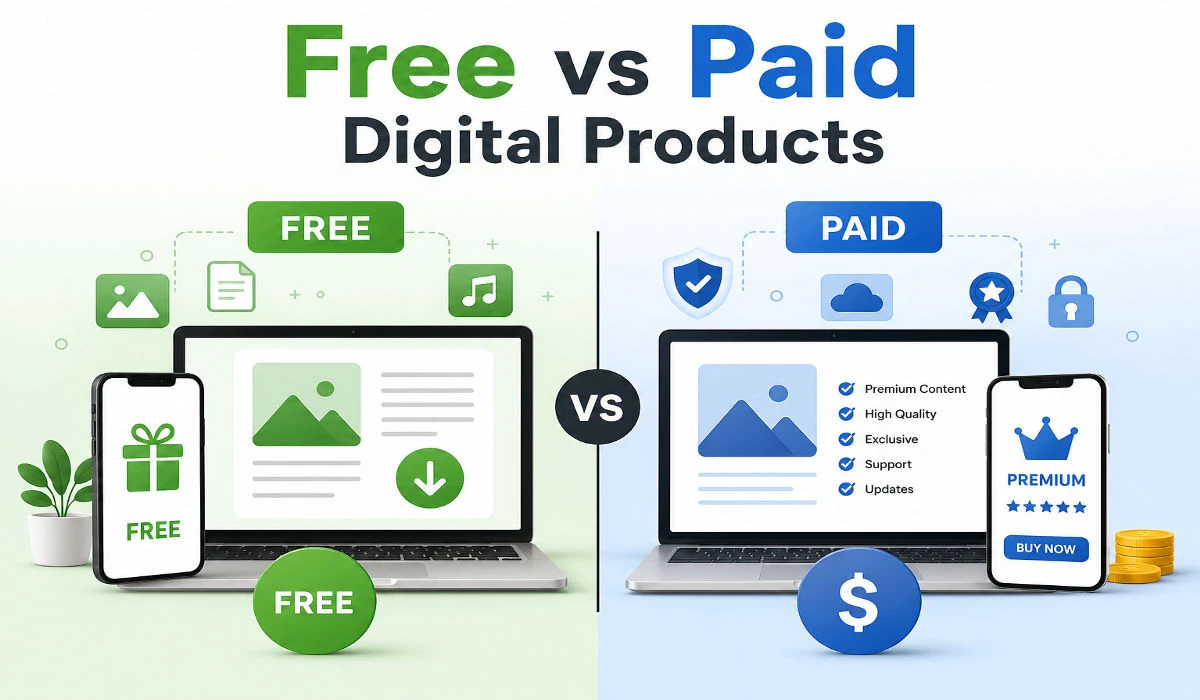
In the competitive world of online business, creators often struggle with a fundamental question: Should I give my knowledge away for free to build an audience, or should I charge for it from day one? The debate of Free vs Paid Digital Products is not just about money; it’s about your overall brand strategy and how you move users through your sales funnel.
Whether you are a blogger, a graphic designer, or a software developer, understanding the balance between Free vs Paid Digital Products is crucial for long-term success. In this guide, we dive deep into the advantages and disadvantages of both models.
Building Trust with Free Digital Products
Free products, often called “Lead Magnets,” are the fastest way to build an email list. By offering a free PDF, checklis, or mini-template, you lower the barrier to entry. When comparing Free vs Paid Digital Products, the biggest advantage of freebies is the ability to showcase your expertise without asking for a financial commitment. It allows potential customers to “test drive” your quality.
Revenue Generation with Paid Digital Products
The most obvious pro of paid assets is immediate cash flow. Unlike freebies, premium products provide you with the capital needed to reinvest in your business. When looking at Free vs Paid Digital Products, paid versions usually offer more depth, better support, and more comprehensive solutions. People perceive paid items as having higher value simply because they have a price tag attached.
The Psychology of “Skin in the Game”
One major downside of free products is that people often download them and never look at them again. However, when a customer pays for a product, they have “skin in the game.” In the context of Free vs Paid Digital Products, paid users are significantly more likely to actually use the product and see results, which eventually leads to better testimonials for your brand.
Viral Growth vs. Sustainable Scaling
Free products have a much higher chance of going viral on social media or platforms like Pinterest. However, virality doesn’t always pay the bills. While a free asset can bring thousands of visitors to digivibess.com, a paid product ensures that the traffic is actually high-quality and willing to spend. Balancing Free vs Paid Digital Products means using freebies for reach and paid products for sustainability.
Support and Maintenance Expectations
When you offer a free digital product, users generally expect minimal support. However, once you transition to the “Paid” side of the Free vs Paid Digital Products spectrum, your responsibility increases. Paid customers expect regular updates, bug fixes, and fast customer service. You must factor these “costs” into your pricing strategy.
Using Free Products as a Sales Funnel
The most successful creators don’t choose between Free vs Paid Digital Products—they use both. A free “lite” version of a tool or a 10-page e-book serves as the perfect entry point. Once the user sees the value in your free content, they are 10x more likely to purchase your high-ticket premium courses or software.
Pros of Free Digital Products
Offering free digital products is a powerful strategy for rapid audience growth and brand awareness. The primary advantage is the zero barrier to entry, which allows you to capture email leads and build a massive marketing list at a very high conversion rate. When analyzing Free vs Paid Digital Products, the “free” model acts as a low-risk entry point for potential customers to experience your expertise and quality firsthand. Furthermore, freebies have a higher viral potential, as users are more likely to share valuable free resources across social media and communities, generating organic traffic and high-authority backlinks to your site without any ad spend.
Cons of Free Digital Products
On the downside, free products often attract “freebie seekers” who may never intend to spend money on your premium offers, leading to a lower-quality email list. A significant disadvantage in the Free vs Paid Digital Products debate is the lack of “skin in the game”; because there is no financial commitment, many users download the asset but never actually use it, which reduces the chance of them seeing real results or providing testimonials. Additionally, managing a large volume of free users can increase your overhead costs for email service providers and hosting, without providing immediate revenue to offset those expenses.
Pros of Paid Digital Products
The most significant benefit of paid digital products is the immediate generation of revenue and the validation of your business model. Unlike freebies, premium products attract serious customers who are committed to solving a problem, which often leads to higher engagement and better success stories. In the context of Free vs Paid Digital Products, the paid model allows you to reinvest profits into better tools, marketing, and product updates, ensuring long-term sustainability. Moreover, charging a price creates a higher perceived value, positioning your brand as a professional authority rather than just another source of free information.
Cons of Paid Digital Products
However, paid products come with higher customer expectations and a much higher barrier to entry. When you choose the “Paid” side of the Free vs Paid Digital Products spectrum, you are responsible for providing consistent updates, dedicated customer support, and a seamless user experience, which can be time-consuming and technically demanding. There is also the risk of “Buyer’s Remorse” and refund requests if the product doesn’t meet the customer’s expectations. Furthermore, marketing a paid product requires a much more complex and expensive sales funnel compared to simply giving away a free lead magnet.
Quality Control and Brand Reputation
Your reputation is tied to everything you release. A common mistake in the Free vs Paid Digital Products debate is thinking that free products can be low quality. In reality, if your free product is bad, no one will ever buy your paid product. Every free asset you release should be good enough that people would have been willing to pay for it.
Customer Feedback and Product Iteration
It is much easier to get feedback on a free product because you have a larger pool of users. Use your free offerings to “beta test” ideas. By analyzing how people use your free tools, you can refine your strategy and create much more effective Paid Digital Products that solve specific, high-value problems for your niche.
Data Collection and Market Research
One of the most underrated pros of offering free assets is the wealth of data you collect. When people download a freebie, you gain insight into what your audience is currently struggling with. In the Free vs Paid Digital Products debate, the “Free” side acts as a giant research lab. You can track which free products get the most downloads and use that data to decide which Paid Digital Products are worth developing. This eliminates the risk of building a paid product that nobody wants.
The Barrier of “Buyer’s Remorse”
Paid products carry the risk of buyer’s remorse—the feeling a customer gets when they regret a purchase. This can lead to refunds and negative reviews. Free products, by nature, carry zero risk for the user. When managing the balance of Free vs Paid Digital Products, you can use high-quality freebies to “pre-sell” the quality of your work. By the time a user decides to buy your paid version, they already trust you, which virtually eliminates buyer’s remorse and keeps your refund rates low.
Affiliate Marketing and Referral Potential
It is significantly easier to get others to share your free products than your paid ones. When comparing Free vs Paid Digital Products, freebies have a much higher “shareability” factor. Influencers and bloggers are more likely to link to a free resource on digivibess.com as a helpful tip for their readers. This generates high-quality backlinks and “word-of-mouth” marketing that eventually funnels people toward your premium, paid offerings.
Intellectual Property and Content Protection
One major “con” of free digital products is that they are frequently stolen or redistributed without credit. Because there is no “paywall,” your content is out in the open. When you move to Paid Digital Products, you can implement protection measures like license keys, password-protected PDFs, or hosting on secure platforms like Teachable or Gumroad. Paid products offer a layer of security and professional respect for your intellectual property that free products simply cannot provide.
Scalability and Automation Costs
As your audience grows, the cost of hosting and delivering “Free” products can actually increase (email marketing fees, server bandwidth, etc.). When evaluating Free vs Paid Digital Products, you must ensure that your paid sales are covering the overhead of your free offerings. A successful digital business uses a small percentage of “Paid” customers to subsidize the marketing costs of the “Free” audience, creating a self-sustaining ecosystem that can scale infinitely.
https://en.wikipedia.org/wiki/Checklist
FAQ
1. When should I stop giving things away for free?
You should never stop entirely. However, once you have established authority and a steady stream of traffic, you should shift your focus to ensuring your “Free” products lead directly into a “Paid” offer.
2. Is it better to have one expensive product or many free ones?
A healthy business needs a mix. Use free products to capture leads and one or two high-quality paid products to generate significant revenue.
3. Do free products hurt the sales of my paid ones?
Only if they are identical. Ensure your paid product offers significantly more value, such as video tutorials, editable files, or personalized support that the free version lacks.
read more: Selling Ebooks vs Courses