The digital asset economy has completely changed how creative and technical professionals work. Instead of building every software script, graphic layout, website code block, or document template from scratch, modern creators can instantly download pre-built files to accelerate their productivity.
However, because digital goods can be copied infinitely with a single click, the legal rules surrounding ownership are incredibly complex. When you buy or download a virtual file, you do not actually own the file itself; you own a specific legal right to use it under strict conditions. Understanding a Complete Guide to Licensing Digital Products Legally is crucial if you want to protect your business from costly copyright infringement lawsuits, take-down notices, and accidental intellectual property theft.
This comprehensive guide will break down the foundational legal definitions, standard digital asset license models, and essential compliance audits you must know to use digital items safely in 2026.
What Does It Mean to License a Digital Product?
To truly grasp a Complete Guide to Licensing Digital Products Legally, you must understand the core legal difference between purchasing a physical asset versus a digital one. When you buy a physical book, the “first sale doctrine” allows you to resell, give away, or destroy that specific copy.
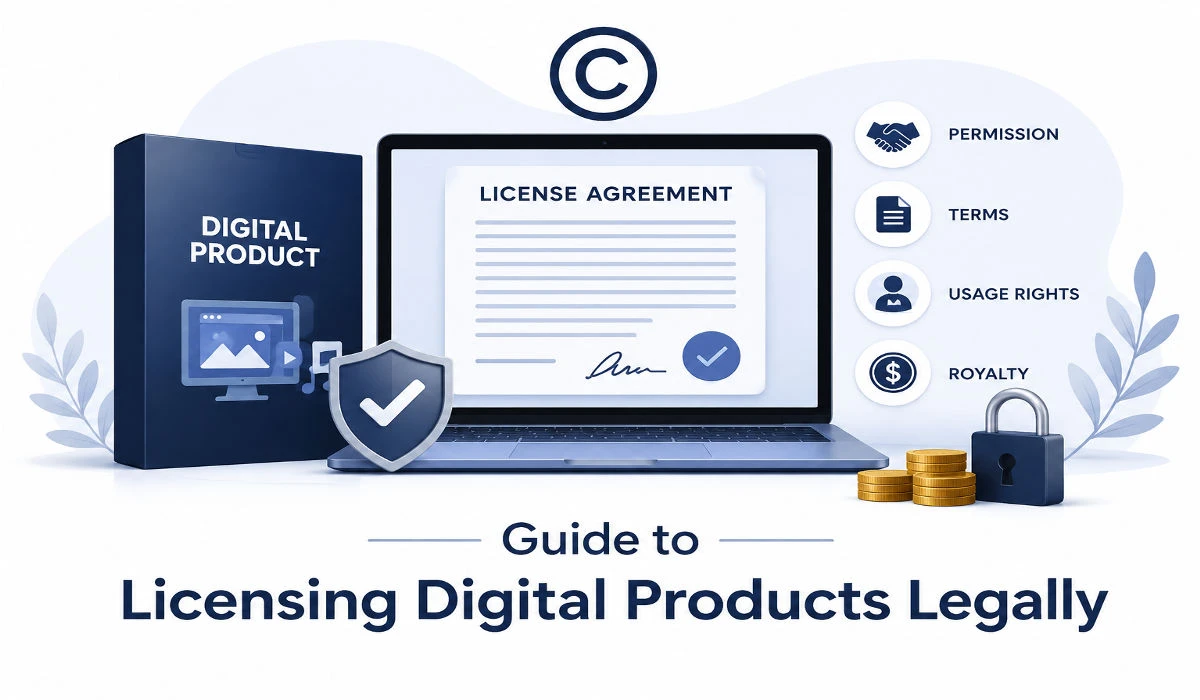
Digital items operate under a completely different framework. When a creator uploads an asset to a marketplace, they retain the full underlying copyright. The checkout payment buys you a license agreement—essentially a legal contract that dictates where, how, and how many times you can use their intellectual property. Failing to read the fine print of this agreement can lead to severe legal penalties, making a Complete Guide to Licensing Digital Products Legally a vital tool for any digital entrepreneur.
Breaking Down Standard Digital Asset Licenses
Not all digital permissions are built the same way. To simplify your workflows and ensure complete legal compliance, standard marketplaces categorize permissions into distinct asset tiers.
A. The Personal Use License
A Personal Use framework is the most restrictive tier available. It allows you to use the downloaded file for personal, non-commercial hobbies that generate zero revenue. For example, if you download a font under this tier, you can use it to design invitations for a private family party. However, you cannot use that font on a business card, a monetization-backed blog header, or a client design project.
B. The Standard Commercial Use License
Moving up the ladder, a key element in any Complete Guide to Licensing Digital Products Legally is the standard commercial tier. This framework allows you to incorporate the digital asset into a commercial project that generates revenue, such as an advertising banner, a corporate presentation, or a YouTube thumbnail. However, it almost always includes strict volume caps—such as limiting the end product to less than 5,000 physical copies or digital views—and strictly prohibits you from reselling the raw asset itself.
Read More: Signs of a Reliable Digital Product Website
Understanding Extended Commercial and PLR Frameworks
For major agencies and digital storefront owners, basic commercial permissions are rarely enough. That is where advanced legal frameworks come into play, forming an essential section of our Complete Guide to Licensing Digital Products Legally.
The Extended Commercial License
If you plan to use an asset on a mass-produced physical product (like printing a vector design onto 50,000 t-shirts for resale), a standard commercial tier will leave you legally exposed. An Extended Commercial agreement completely removes distribution volume caps, giving you the legal freedom to scale your production limits safely.
Private Label Rights (PLR) and Resell Rights
PLR represents a unique category where the original author explicitly sells you the right to modify, rebrand, and resell the content as your own. When studying a Complete Guide to Licensing Digital Products Legally, always verify whether your PLR agreement requires you to alter a certain percentage of the asset before putting it up for sale on your own storefront.
How to Conduct a Pre-Use Digital License Audit
Before you deploy a newly downloaded template or code script on a live client project, you must perform a quick compliance check.
First, look inside the downloaded folder for a file explicitly named LICENSE.txt or README.pdf. Professional creators always package their specific usage terms directly alongside the source code. Second, save a PDF copy of the invoice and the sales page terms at the exact time of purchase. Storefronts can change their terms over time, and having a timestamped archive is your ultimate insurance policy if an ownership dispute ever arises.
Strategic Tag Cloud for SEO Optimization
digital asset legal guidelines, commercial product licenses explained, understanding private label rights, avoid digital copyright lawsuits, how to use templates legally, extended commercial rights 2026, font licensing compliance guide, wordpress plugin usage rules, safe asset downloading legalities, intellectual property protection tips
Common Legal Pitfalls and How to Avoid Them
Many digital business owners run into trouble not out of malice, but out of basic misunderstanding. A crucial lesson in a Complete Guide to Licensing Digital Products Legally is learning how to recognize hidden restrictions.
The Single-Seat Trap: Many software assets and design templates are sold on a “per-user” basis. If you buy a single license and install it across five team computers, you are actively violating copyright terms.
The Sublicensing Myth: You cannot buy a digital template, make minor color tweaks, and then resell the asset code to another developer unless the original creator explicitly authorized sublicensing terms.
Navigating Open-Source and Copyleft Licenses
When building digital systems, you will frequently encounter open-source assets, particularly when dealing with software code, web frameworks, or WordPress elements. A vital chapter in any Complete Guide to Licensing Digital Products Legally involves understanding frameworks like the GNU General Public License (GPL) or MIT permissions. Unlike restrictive proprietary terms, open-source structures generally grant you the freedom to modify, scale, and redistribute code without paying ongoing royalties.
However, open-source does not mean completely lawless. Certain copyleft agreements stipulate that if you alter their open-source code to create a new application, your final product must also be released as open-source. Reviewing these specific developer parameters as part of your Complete Guide to Licensing Digital Products Legally ensures that you do not accidentally expose your proprietary business software to mandatory public distribution requirements.
Managing Licenses in Team Environments and Client Handoffs
Another critical operational hurdle is tracking how permissions transfer when a project moves from your internal team over to an external client. To properly maintain a Complete Guide to Licensing Digital Products Legally, you must establish clean handoff protocols. If your agency purchases a commercial template to build a client’s website, the legal terms usually dictate that the license is tied exclusively to that single finished project and cannot be recycled for a second client.
If a client later requires direct access to the raw design elements or source files for independent updates, they must typically purchase their own standalone seat. Incorporating these strict asset-management rules into your Complete Guide to Licensing Digital Products Legally protects your agency from structural liability, ensuring that both your design team and your end-clients remain fully compliant with global intellectual property laws.
FAQ
Q1. What happens if I accidentally violate a digital asset license?
Ans: The copyright owner will typically issue a DMCA (Digital Millennium Copyright Act) takedown notice to your web host, which can temporarily shut down your site. If the violation continues or causes severe financial damage, they can pursue formal statutory damages in a court of law.
Q2. If an asset is labeled “Free Download,” can I use it for my business?
Ans: Not automatically. “Free” often refers only to the acquisition cost, not the usage rights. Many free files are restricted strictly to personal hobbies. Always locate the official terms to verify if it includes a free commercial license.
Q3. Do digital product licenses ever expire?
Ans: Most premium asset licenses are “perpetual,” meaning they last a lifetime once purchased. However, some subscription-based platforms stipulate that you can only use their assets in new projects while your monthly membership remains active.
Conclusion
Building a scalable, high-performing digital system requires an analytical approach to your resource library. Navigating the legal landscape doesn’t have to be overwhelming if you treat every downloaded file with systematic care.
By committing to the strategies outlined in this Complete Guide to Licensing Digital Products Legally—carefully separating personal from commercial tiers, avoiding single-seat traps, and maintaining strict invoice archives—you completely eliminate legal risk from your creative pipeline. Build your business on a foundation of legal clarity, respect the intellectual property of fellow developers, and build an asset library that securely elevates your long-term professional ventures.