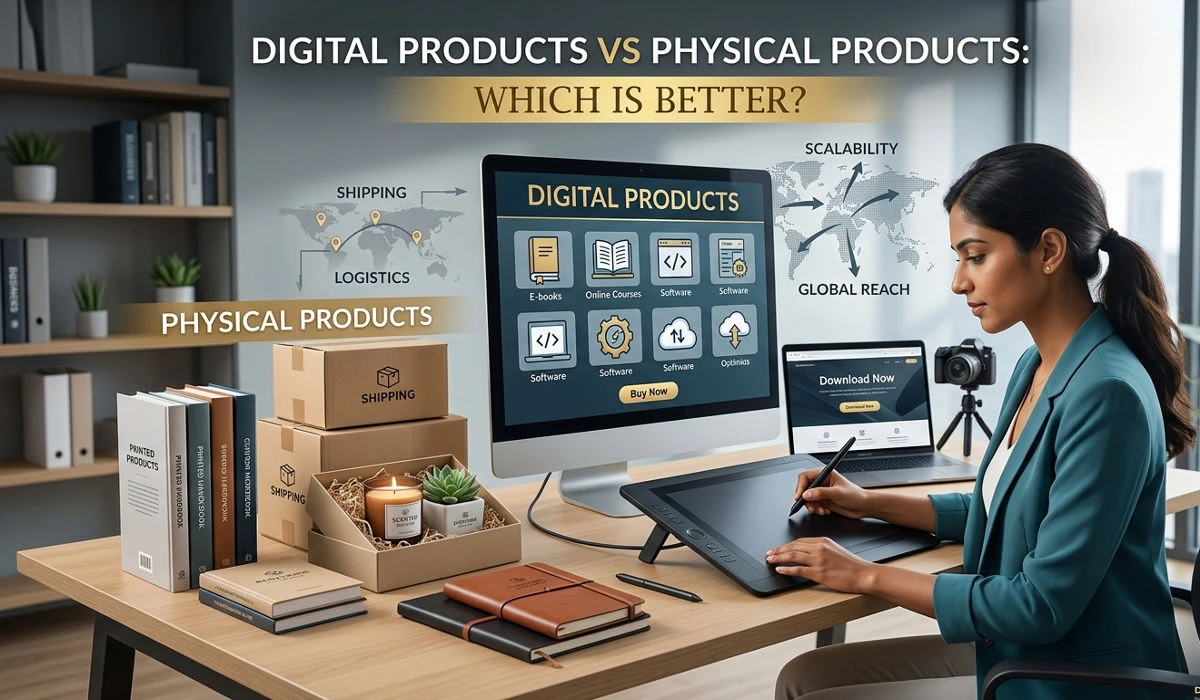
The e-commerce landscape of 2026 offers unprecedented opportunities for entrepreneurs. However, before you write a single line of code, buy raw materials, or build a storefront, you face a foundational decision that will shape your entire business model: Digital Products vs Physical Products: Which Is Better?
Some entrepreneurs swear by the infinite scalability of digital assets, while others argue that the tactile trust of a tangible item cannot be replicated. This comprehensive guide breaks down both models across profit margins, operational complexity, scalability, and market demand to help you decide which path is right for your entrepreneurial journey.
Defining the Contenders
To fairly answer Digital Products vs Physical Products: Which Is Better?, we must first look at what each business model looks like in today’s digital economy.
What are Digital Products?
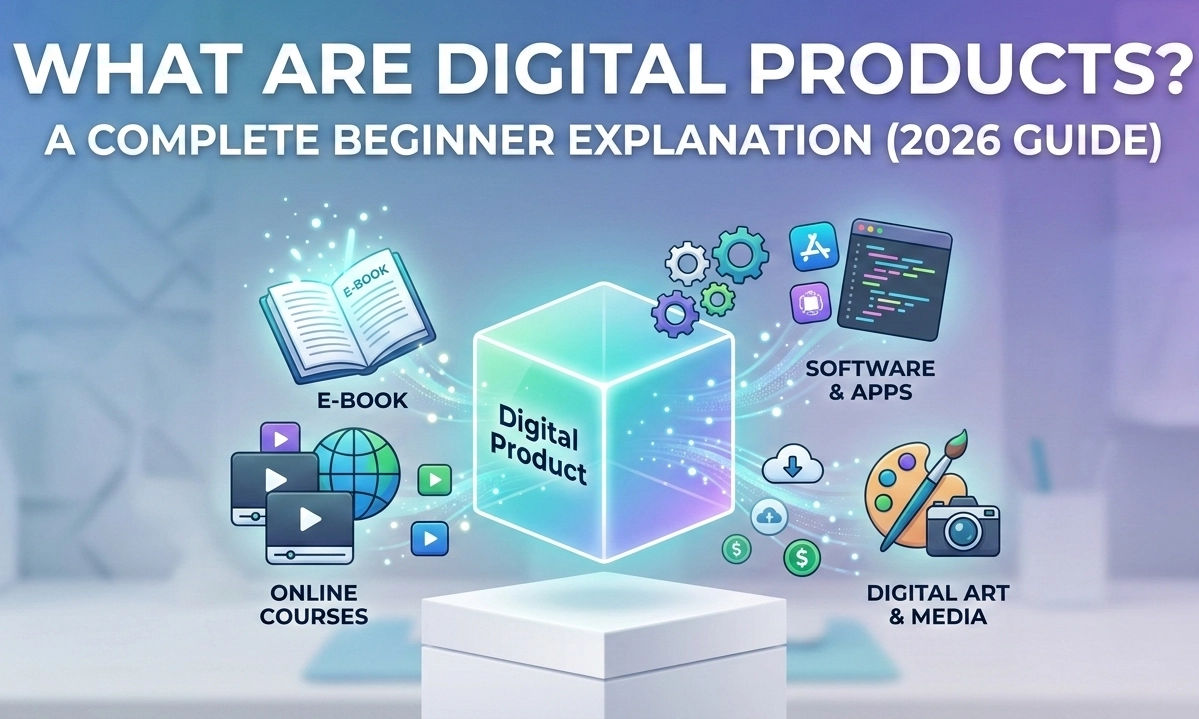
Digital products are intangible assets or media pieces that can be sold and distributed repeatedly online without the need to replenish inventory.
Examples: Online courses, SaaS applications, e-books, website themes, downloadable templates, and stock audio/video.
What are Physical Products?
Physical products are tangible items that require manufacturing, inventory management, physical storage, and shipping logistics.
Examples: Apparel, consumer electronics, supplements, handcrafted home decor, and subscription boxes.
The Financial Showdown
When analyzing Digital Products vs Physical Products: Which Is Better?, your net profit margin is often the most convincing metric.
The Digital Advantage
Digital products have an almost unbeatable financial structure. You invest time, effort, or capital to create the asset once, and you can sell it ten thousand times.
Cost of Goods Sold (COGS): Near zero. Aside from web hosting, transaction fees, and marketing, every dollar earned is pure profit.
Average Profit Margins: 70% to 90%.
The Physical Reality
Physical products carry overhead costs at every stage of the supply chain. Every single unit sold incurs a direct cost to produce or source.
Overhead Expenses: Raw materials, manufacturing, warehousing, packaging, and shipping insurance.
Average Profit Margins: 20% to 40%.
The Verdict on Margins: If your main goal is minimizing overhead and maximizing net take-home pay per sale, digital products win definitively.
Read More: Where to Buy Affordable Digital Downloads Safely
Scalability and Operational Complexity
Scalability is the ease with which a business can handle an increase in demand without being crippled by operational costs or logistics.
Scaling a Digital Storefront
With digital products, selling 10 units a day requires the exact same operational effort as selling 1,000 units a day. Your delivery system is fully automated via immediate email or account downloads. The only element that scales with your growth is customer support and server bandwidth.
Scaling a Physical Storefront
Scaling a physical product business introduces exponential logistical hurdles.
If demand spikes by 500%, you must immediately buy more inventory, hire more warehouse staff, and manage massive supply chain pipelines.
Shipping delays, damaged packages, and custom clearances can disrupt your entire cash flow.
Consumer Psychology and Perceived Value
Money and logistics aside, how do consumers actually view these items? This is where the debate over Digital Products vs Physical Products: Which Is Better? takes an interesting turn.
The Tangibility Factor
Physical products possess an innate psychological advantage: perceived value. When a customer receives a beautifully packaged box, they feel an immediate sense of ownership and satisfaction. They can hold it, touch it, and showcase it. This physical connection makes it much easier to justify higher luxury price tags.
The Friction of Digital Goods
Digital products, by contrast, can feel abstract. Customers sometimes struggle to justify paying high prices for something they cannot physically touch. This is why successful digital creators must spend heavily on high-end copy, video testimonials, and extensive feature lists to prove the practical value of their downloadable assets.
Risk Management and Longevity
Every business owner must prepare for market shifts, platform changes, and financial risks.
Risks Inherent to Digital Goods
Piracy and Theft: Digital files can be copied, shared on forums, or leaked easily.
Low Barrier to Entry: Because anyone with a laptop can create a digital download, spaces like Notion templates or generic e-books can become saturated quickly.
Risks Inherent to Physical Goods
Dead Stock: If you buy 500 units of a trendy product and the trend dies, you are left with capital trapped in boxes taking up expensive warehouse space.
Liability & Damages: Broken items during transit or manufacturing defects can destroy your brand reputation overnight and lead to costly product returns.
The Hybrid Solution
As you weigh Digital Products vs Physical Products: Which Is Better?, remember that you don’t always have to choose just one. Many of the most successful e-commerce brands in 2026 deploy a hybrid model.
Examples of Hybrid Ecosystems:
Fitness Brands: Selling physical equipment (dumbbells, resistance bands) alongside a digital subscription app for guided workouts.
Artists: Selling physical canvas prints alongside digital Procreate brushes and online drawing tutorials.
Tech Companies: Selling a physical piece of hardware that requires a digital SaaS subscription to function fully.
Which Business Model Is Best For You?
Ultimately, answering Digital Products vs Physical Products: Which Is Better? depends entirely on your current resources, skills, and professional goals.
Choose Digital Products If:
You have a limited budget and want to start with minimal financial risk.
You possess a specialized skill set (coding, design, writing, or teaching) that you can package into an asset.
You want to run a location-independent business with automated passive income streams.
Choose Physical Products If:
You are passionate about product design, manufacturing, or curating tangible collections.
You want to build a recognizable consumer brand that lives in people’s homes.
You excel at logistics, supply chain management, and creating memorable unboxing experiences.
Whichever path you choose, the key to success remains the same: solve a real problem for your audience, protect your brand’s security, and deliver uncompromised quality.
Customer Lifetime Value (LTV) and Retention Strategies
When evaluating Digital Products vs Physical Products: Which Is Better?, you must look beyond the first transaction. Long-term business sustainability depends heavily on customer lifetime value (LTV) and how easy it is to keep buyers coming back.
Digital assets open up massive opportunities for recurring revenue models. If you sell an online course, a software plugin, or a membership program, you can transition a one-time buyer into a monthly subscriber. This compounding revenue completely shifts the perspective on Digital Products vs Physical Products: Which Is Better? because digital retention costs almost nothing. There are no items to physically re-ship to keep the subscriber happy.
Physical storefronts, on the other hand, require continuous product innovation to maintain high retention rates. If a customer buys a pair of shoes, they will not buy another pair next month unless you launch a new collection or run an expensive retargeting campaign. When analyzing Digital Products vs Physical Products: Which Is Better? through the lens of customer retention, digital goods provide a smoother, more predictable path to a high lifetime value.
Customer Support and Post-Purchase Friction
Another critical angle to analyze is the amount of customer service infrastructure your business will require. The operational stress of handling buyer issues plays a huge role when deciding Digital Products vs Physical Products: Which Is Better? for solo entrepreneurs.
Physical items naturally generate a high volume of post-purchase tickets. You will regularly deal with packages lost in transit, items damaged by couriers, or customers requesting exchanges due to sizing issues. These logistical headaches force many store owners to hire dedicated customer service teams early on. If you are trying to determine Digital Products vs Physical Products: Which Is Better? based on peace of mind and low operational friction, physical fulfillment demands a lot more day-to-day management.
FAQ
Q1. Is it easier to start selling digital products or physical products?
Ans: Digital products are significantly easier to start selling because they eliminate the need for upfront manufacturing capital, warehouses, and complex shipping setups. You can launch a digital store in a single day using platforms like Gumroad or Etsy.
Q2. How do I protect my digital products from being pirated?
Ans: While it is impossible to stop piracy entirely, you can minimize it by using secure delivery platforms, adding digital watermarks, utilizing license keys for software, and issuing formal DMCA take-down notices when you spot unauthorized distribution.
Q3. Can I transition from physical products to digital products later?
Ans: Absolutely. Many physical product brands introduce digital products—such as instructional e-books, exclusive community memberships, or utility mobile apps—to increase their overall profit margins and customer lifetime value.