One of the biggest challenges for online creators isn’t building the product—it’s deciding what to charge for it. Unlike physical goods, digital assets have near-zero marginal costs, which makes the question of how to price digital products for maximum profit both exciting and confusing.
If you price too low, you devalue your expertise. If you price too high, you scare away potential customers. In this guide, we will break down the exact frameworks you need to optimize your revenue.
Move from Cost-Plus to Value-Based Pricing
The first step in how to price digital products for maximum profit is shifting your mindset. Many beginners try to price based on how many hours they spent creating the product. In 2026, the market doesn’t care about your time; it cares about its own results.
Value-based pricing looks at the “Return on Investment” (ROI) for the customer. If your $100 ebook saves a business owner 10 hours a week (valued at $500), your product is a bargain. This is the core secret to high-margin digital sales.
The Power of Tiered Pricing
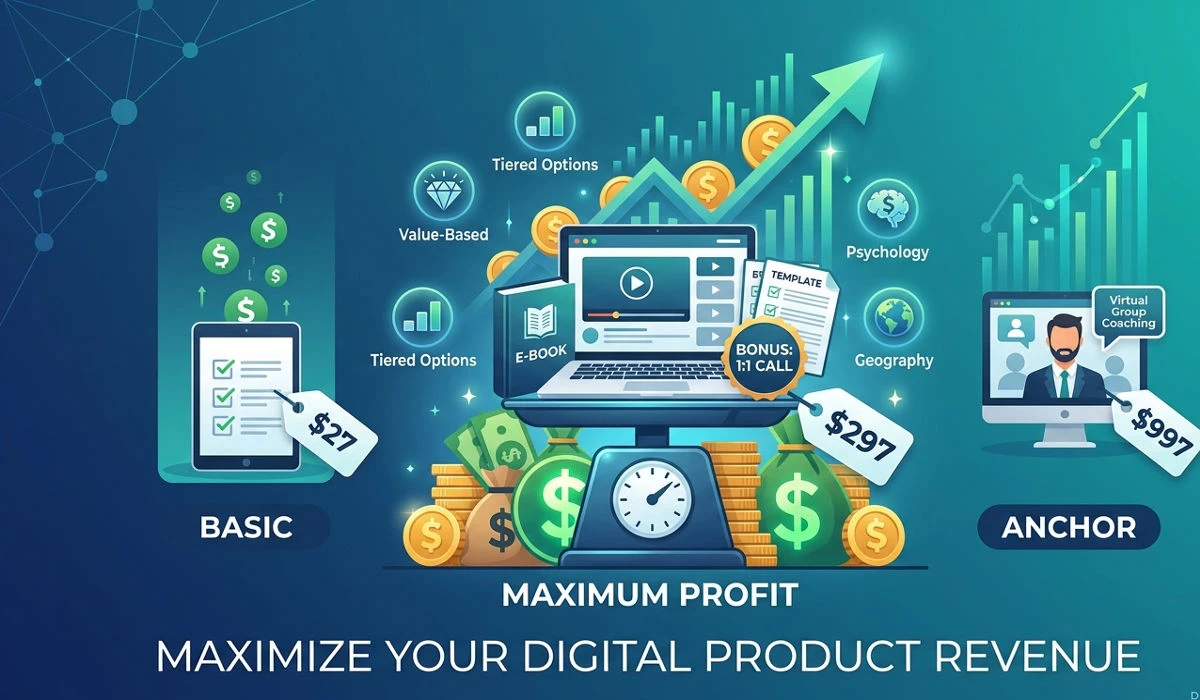
If you offer only one price, you are leaving money on the table. A crucial strategy in how to price digital products for maximum profit is offering tiers—usually “Basic,” “Pro,” and “Master.”
Basic: The core product.
Pro: The product + templates or checklists.
Master: The product + video training or a 1:1 call.
By adding a high-priced “Anchor” tier, your middle tier looks like the best value, significantly increasing your conversion rate.
Utilize Psychological Pricing Triggers
Numbers aren’t just math; they are emotional. When researching how to price digital products for maximum profit, you’ll find that “Charm Pricing” (ending in .97 or .99) still works wonders. In 2026, $47 or $97 feels significantly cheaper to a buyer than $50 or $100. Additionally, using “Price Anchoring”—showing a higher “original” price crossed out—creates a sense of urgency and perceived savings.
The “Freemium” to Premium Funnel
You cannot ignore the “Free” factor when learning how to price digital products for maximum profit. By offering a low-cost “Tripwire” product (e.g., $7–$19), you turn a visitor into a buyer. Once they have made that first small transaction, they are 10x more likely to purchase your “Maximum Profit” product later.
Dynamic Pricing and Seasonal Discounts
Static pricing is a thing of the past. To maximize profit, use dynamic pricing based on demand or specific events. Flash sales, early-bird discounts for new launches, and holiday bundles are essential tactics. When you understand how to price digital products for maximum profit, you learn to use “Scarcity” (limited-time offers) to drive immediate sales volume.
Factor in Platform Fees and Taxes
You cannot calculate maximum profit without looking at the “hidden” costs. Whether you use Gumroad, LemonSqueezy, or your own WordPress site on digivibess.com, factor in the 3%–10% transaction fees. Understanding how to price digital products for maximum profit means setting a price high enough that these fees don’t eat into your actual take-home income.
The “Price Increase” Strategy
Don’t be afraid to raise your prices as your product gains more testimonials and social proof. In fact, announcing a future price increase is a brilliant way to price digital products for maximum profit because it forces “on-the-fence” buyers to take action now before the price goes up.
Read More: Free vs Paid Digital Products
Implement the “Decoy Effect” Strategy
One of the most effective psychological hacks in how to price digital products for maximum profit is the Decoy Effect. This involves adding a third pricing option that is intentionally less attractive than your “target” option. For example, if you have a “Digital Book” for $30 and a “Full Video Masterclass” for $100, you might add a “Physical Book + Video” bundle for $105. By making the $105 option seem like an incredible deal compared to the $100 one, you push customers toward the higher-priced package, increasing your overall profit margins.
Price for “Transformation,” Not “Information”
In 2026, information is everywhere for free (YouTube, AI, etc.). To price digital products for maximum profit, you must market the transformation. People don’t pay $500 for a course on “How to use Excel”; they pay $500 for “How to Save 20 Hours of Work per Week and Get a Promotion.” When your pricing reflects the financial or emotional outcome for the customer, you can charge significantly more than your competitors who are just selling “info.”
Geography-Based Power Pricing (PPP)
If you want to reach a global audience on digivibess.com, you should consider Purchasing Power Parity (PPP). This involves offering localized pricing based on the customer’s country. A $97 product might be affordable in the US but impossible to buy in a developing economy. By using tools that automatically adjust the price based on the user’s location, you can maximize your sales volume globally. Selling 100 copies at a lower price in a new market is better for your total profit than selling zero at a “fixed” high price.
The “Anchor and Contrast” Technique
When presenting your price, always show the “Potential Loss” or the “Alternative Cost” first. For example, tell your audience that hiring a consultant for this task would cost $2,000. Then, reveal that your digital toolkit is only $197. By creating a high “Anchor” ($2,000), your actual price feels like a massive saving. This contrast is essential when learning how to price digital products for maximum profit because it justifies your price point before the customer even sees it.
Bundling Complementary Assets
Bundling is a classic yet powerful way to price digital products for maximum profit. Instead of selling one PDF for $20, bundle it with a spreadsheet, a checklist, and a 10-minute video for $67. The “perceived value” of multiple items is much higher than a single item, even if the extra assets took you very little time to create. Bundles allow you to increase your “Average Order Value” (AOV), which is the fastest way to grow your revenue without needing more traffic.
FAQ
1. Is it better to start cheap and raise the price later?
Yes. Starting lower allows you to gather testimonials quickly. Once you have “social proof,” you can confidently raise the price to maximize your profit margins.
2. Should I offer a lifetime deal or a subscription?
For digital assets like templates, a one-time fee is usually better. For tools that require updates, a subscription (SaaS) provides the highest lifetime value.
3. How do I know if my price is too high?
If you have high traffic but a conversion rate below 1%, your price might be misaligned with the perceived value.