Deciding where to host your digital empire is a critical business decision. In 2026, creators are no longer just looking for a “Buy” button; they are looking for tax compliance, high conversion rates, and long-term scalability.
This Gumroad vs Etsy vs Shopify for Digital Products comparison will break down exactly which platform fits your current stage of growth.
The Simplest Path for Indie Creators
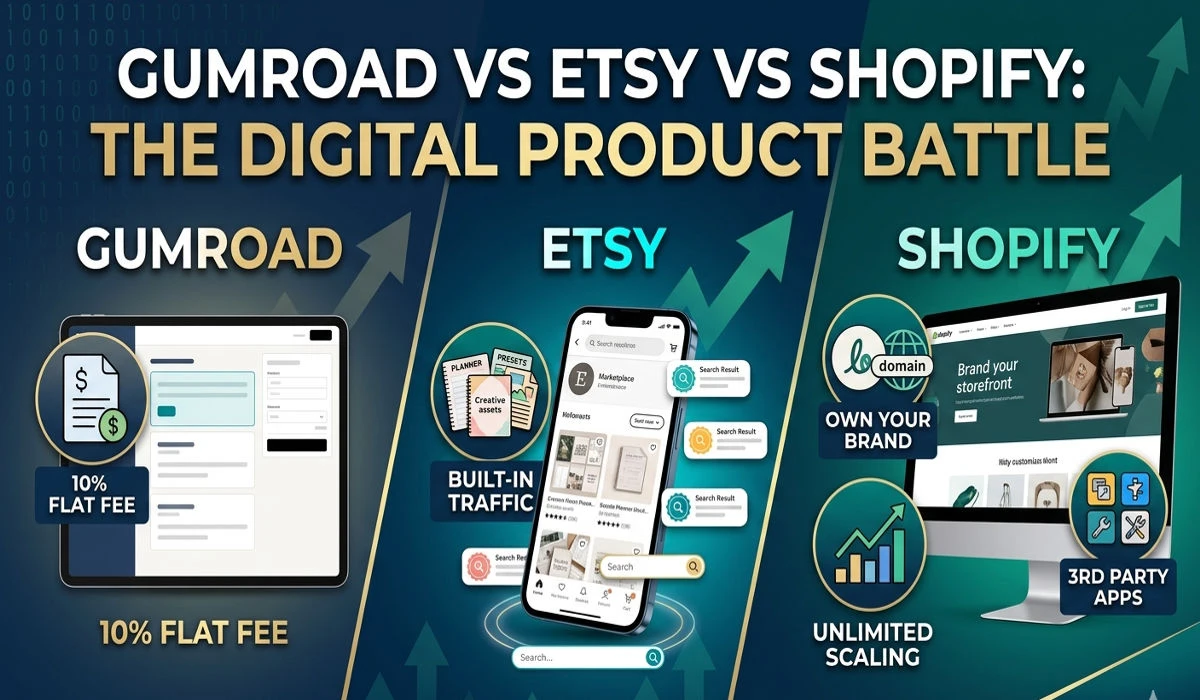
When analyzing Gumroad vs Etsy vs Shopify for Digital Products, Gumroad stands out as the ultimate “frictionless” choice. It is designed for creators who want to go from “idea” to “sale” in under ten minutes.
- Pricing: A flat 10% transaction fee. No monthly subscription.
- Best For: Selling single assets like PDFs, small software tools, or simple video tutorials.
- The Verdict: Use Gumroad if you have your own audience (on Twitter or a newsletter) and want zero upfront costs.
The Organic Traffic Powerhouse
In the Gumroad vs Etsy vs Shopify for Digital Products debate, Etsy is the only platform that brings customers to you. It functions more like a search engine (similar to Amazon) than a standalone store.
Pricing: $0.20 listing fee + 6.5% transaction fee + payment processing.
Best For: Graphic templates, digital planners, and artistic presets.
The Verdict: Choose Etsy if you are a beginner with no following and need the marketplace’s built-in 90+ million active buyers to find your work.
The Gold Standard for Scalable Brands
Shopify is the heavyweight champion in the Gumroad vs Etsy vs Shopify for Digital Products lineup. While it requires the most setup, it offers the highest level of professional control.
Pricing: Starting at $39/month + lower transaction fees (around 2.9%).
Best For: Serious entrepreneurs who want to own their domain, customer list, and complete brand aesthetic.
The Verdict: Migrate to Shopify when your sales exceed $1,000/month. At this volume, Shopify’s flat monthly fee becomes cheaper than Gumroad’s 10% cut.
Understanding Customer Ownership
A vital part of the Gumroad vs Etsy vs Shopify for Digital Products comparison is who “owns” the customer.
- On Etsy, you are selling on their platform; they own the data.
- Gumroad allows you to collect emails, which is great for future marketing.
- Shopify gives you full data ownership, allowing for advanced retargeting and professional CRM management.
Global Tax and VAT Compliance
In 2026, handling digital taxes is a nightmare.
- Gumroad and Etsy act as the “Merchant of Record,” meaning they collect and pay the VAT for you.
- On Shopify, you are responsible for your own taxes, though apps like Avalara or TaxJar can automate this. For a solo creator, Gumroad or Etsy might be safer legally.
Read More: Subscription vs One-Time Digital Products Comparison
The “Hybrid” Strategy for Maximum Profit
You don’t have to choose just one! Many successful sellers on digivibess.com use a hybrid approach in the Gumroad vs Etsy vs Shopify for Digital Products ecosystem:
- Start on Etsy to validate your product using their free traffic.
- Move to Gumroad to sell to your growing social media followers without monthly fees.
- Scale to Shopify once your revenue is high enou cargh to justify a professional standalone store.
SEO and Organic Discovery
When comparing Gumroad vs Etsy vs Shopify for Digital Products, the way customers find you varies wildly.
- Etsy has a powerful internal search engine; if you use the right tags, Etsy does the SEO work for you.
- Shopify gives you the most advanced SEO tools (custom meta tags, schema markup, and high-speed global CDNs), but you must build your own authority from scratch.
- Gumroad offers basic SEO but relies heavily on its “Discover” marketplace, which takes an extra commission for finding customers for you.
App Ecosystem and Feature Expansion
A major technical factor in the Gumroad vs Etsy vs Shopify for Digital Products battle is how much you can grow.
- Shopify has thousands of apps for email marketing, upsells, and affiliate management.
- Etsy is a “closed” system—you can’t add third-party plugins.
- Gumroad is built-in; you get what they give you. If you need complex features like “drip-feeding” course content or custom license keys for software, Shopify’s app store wins every time.
Checkout Customization and Conversion Rates
First impressions matter. In a Gumroad vs Etsy vs Shopify for Digital Products comparison, look at the checkout flow.
- Gumroad is famous for its “minimalist” checkout that converts high because it’s so fast.
- Shopify allows you to fully customize your checkout (on higher plans) to match your brand.
- Etsy checkouts are branded as “Etsy,” which means the customer is loyal to the platform, not necessarily your brand.
Analytics and Data Deep-Dives
You cannot improve what you don’t measure.
- Shopify provides enterprise-level analytics, showing you exactly where customers dropped off and which marketing channel (TikTok, Google, or Email) brought the most profit.
- Etsy provides “Shop Stats” which are great for beginners but lack deep tracking.
- Gumroad analytics are simple—focusing mainly on views and sales—making Gumroad vs Etsy vs Shopify for Digital Products a choice between data-depth and simplicity.
Transaction Fees vs. Scaling Math
The “Math” of Gumroad vs Etsy vs Shopify for Digital Products changes as you grow.
- At $100/month, Etsy or Gumroad is cheapest because there’s no high monthly fee.
- At $5,000/month, Gumroad’s 10% fee ($500) is much more expensive than Shopify’s $39/month + 2.9% fee (~$184 total).
For long-term profit, Shopify becomes the most cost-effective platform once you hit a consistent sales volume.
Security and Digital Rights Management
Protecting your hard work is vital.
- Shopify apps allow for “PDF Stamping” (putting the buyer’s email on every page) and expiring download links to prevent piracy.
- Gumroad has basic file protection and streaming-only options for videos.
- Etsy provides simple download links but lacks advanced protection. In the context of Gumroad vs Etsy vs Shopify for Digital Products, Shopify offers the best tools to stop people from sharing your products for free.
FAQ
1. Which platform is the cheapest for low-volume sellers?
Etsy is the cheapest for testing a few items because the listing fee is only $0.20. However, Gumroad is better if you only want to pay when you actually make a sale.
2. Can I use my own domain on all three?
Shopify is built for custom domains. Gumroad allows it on premium plans. Etsy does not allow custom domains for your shop page (it will always be etsy.com/shop/yourname).
3. Is Shopify worth it for just one ebook?
Generally, no. Shopify’s monthly fee is too high for a single low-priced product. Stick to Gumroad until you have a suite of products.