In the ever-evolving world of digital entrepreneurship, choosing the right monetization model can make or break your brand’s longevity. When building an online empire, creators often find themselves at a crossroads: Subscription vs One-Time Digital Products Comparison.
Should you aim for a single, high-ticket sale, or focus on building a recurring revenue stream? This comprehensive guide breaks down the financial, technical, and psychological aspects of both models to help you decide which path is right for your digital store.
The Predictability of Recurring Revenue
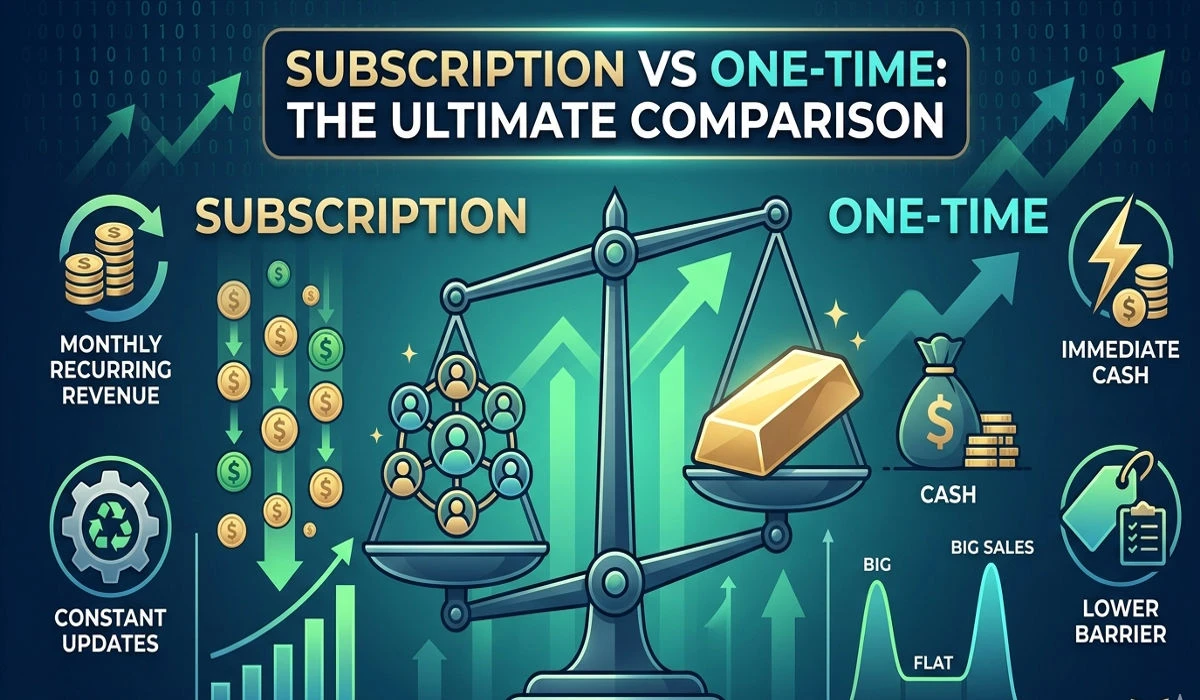
The most significant factor in a Subscription vs One-Time Digital Products Comparison is income stability.
- Subscriptions: Provide monthly recurring revenue (MRR), which allows for better business planning, hiring, and scaling.
- One-Time: Leads to a “peaks and valleys” income cycle where you must constantly find new customers to maintain your lifestyle.
In 2026, investors and business owners prefer the subscription model because it creates a predictable “floor” for your revenue every month.
Customer Acquisition Cost (CAC) vs. Lifetime Value (LTV)
When looking at a Subscription vs One-Time Digital Products Comparison, you must evaluate how much you spend to get a customer versus how much they pay you over time.
- One-Time Products: You pay to acquire a customer once for a single transaction. If they don’t buy again, your profit is limited.
- Subscriptions: While the initial sale might be harder, the “Lifetime Value” (LTV) is often 5x to 10x higher because the customer stays for months or years.
Maintenance and Content Delivery Expectations
Expectations vary wildly depending on the model. This is a critical technical point in any Subscription vs One-Time Digital Products Comparison.
- One-Time: Buyers expect a finished, polished product. Once they download it, your job is largely done.
- Subscription: Buyers expect constant updates, new monthly content, community access, and premium support. If you stop providing fresh value, your “Churn Rate” (the rate at which people cancel) will skyrocket.
Barrier to Entry and Psychological Pricing
Pricing psychology plays a massive role in Subscription vs One-Time Digital Products Comparison.
- One-Time: A $200 course might feel expensive, creating a high barrier to entry.
- Subscription: A $19/month membership feels much more affordable, even though the customer might end up paying $400 over two years.
Subscriptions use “micro-commitments” to lower the barrier, while one-time sales require a high level of trust and authority.
Read More: How to Build a Digital Product Store That Converts
The Silent Revenue Killer
In any Subscription vs One-Time Digital Products Comparison, you must discuss churn. For subscription businesses, losing 10% of your members each month can be devastating. One-time products don’t have churn, but they do have “market fatigue”—where you eventually run out of new people to sell to in a specific niche.
The Best of Both Worlds
Many professional sellers on digivibess.com are moving toward a hybrid approach. This involves selling a “core” one-time product (like a Masterclass) and offering an optional “Subscription” for monthly coaching or updated assets. This allows you to get the immediate cash injection of a big sale while building long-term stability.
Platform and Technical Requirements
The technical side of Subscription vs One-Time Digital Products Comparison is often overlooked. Subscriptions require specialized billing software (like Stripe, LemonSqueezy, or MemberPress) that can handle recurring charges, failed credit cards, and customer portals. One-time products are much simpler to host on basic platforms like Gumroad or Etsy.
Strategic Pricing for Maximum Profit
To maximize profit, your pricing must align with your delivery.
- Use One-Time pricing for tools that solve a “one-and-done” problem (e.g., a Resume Template).
- Use Subscription pricing for tools that provide ongoing value or solve a recurring problem (e.g., SEO tracking tools or Monthly Design Assets).
Customer Loyalty and Community Dynamics
In a Subscription vs One-Time Digital Products Comparison, the level of community engagement is a massive differentiator. Subscription models naturally foster a “club” atmosphere where members interact with you and each other regularly. This community aspect creates “social stickiness,” making it harder for customers to cancel because they don’t want to lose the network. One-time products are usually a solo experience; once the file is downloaded, the relationship often ends, making it harder to build a dedicated brand “tribe.”
The Impact on Brand Valuation and Exit Strategy
If you ever plan to sell your business, the model you choose is critical. Investors value companies with recurring revenue much higher than those relying on one-time sales. In a Subscription vs One-Time Digital Products Comparison, a subscription-based store on digivibess.com could be valued at 3x–5x its annual profit, whereas a one-time sales store might only fetch 1x–2x. Recurring revenue proves that your business has a future, not just a successful past.
Content Fatigue and the “Treadmill” Effect
A significant “con” of the subscription model that must be mentioned in any Subscription vs One-Time Digital Products Comparison is the content treadmill. As a subscription creator, you are under constant pressure to deliver new value every month to prevent churn. If you have a busy month or run out of ideas, your subscribers will feel the dip in quality immediately. One-time products allow you to work in bursts—you create a masterpiece, launch it, and then rest while it generates passive income.
Upsell and Cross-sell Opportunities
The sales architecture differs greatly between these two. With One-Time products, the upsell usually happens immediately at the checkout (e.g., “Add this checklist for $10”). In a Subscription vs One-Time Digital Products Comparison, the subscription itself is the “anchor.” Once a user is in your ecosystem, you can cross-sell them “Special Edition” one-time products or high-ticket coaching. The subscription acts as a filter that identifies your most loyal fans, making future sales much easier.
Regulatory and Legal Complexity
In 2026, global laws surrounding “Automatic Renewals” have become very strict. A technical point in the Subscription vs One-Time Digital Products Comparison is that subscriptions require clear cancellation paths, renewal reminders, and specific refund policies to stay compliant with international consumer laws. One-time purchases are legally simpler; once the transaction is complete and the product delivered, the legal relationship is much more straightforward.
FAQ
1. Can I switch from One-Time to Subscription later?
Yes, but it is difficult. Existing customers often feel “cheated” if they suddenly have to pay monthly for something they used to own. It is better to launch a “Version 2.0” as a subscription.
2. Which is better for beginners?
One-Time products are generally better for beginners because they require less infrastructure and no long-term commitment to providing monthly updates.
3. Does the Subscription model work for E-books?
Usually no. However, a “Library Access” subscription (where users pay monthly to access 50+ E-books) works very well.