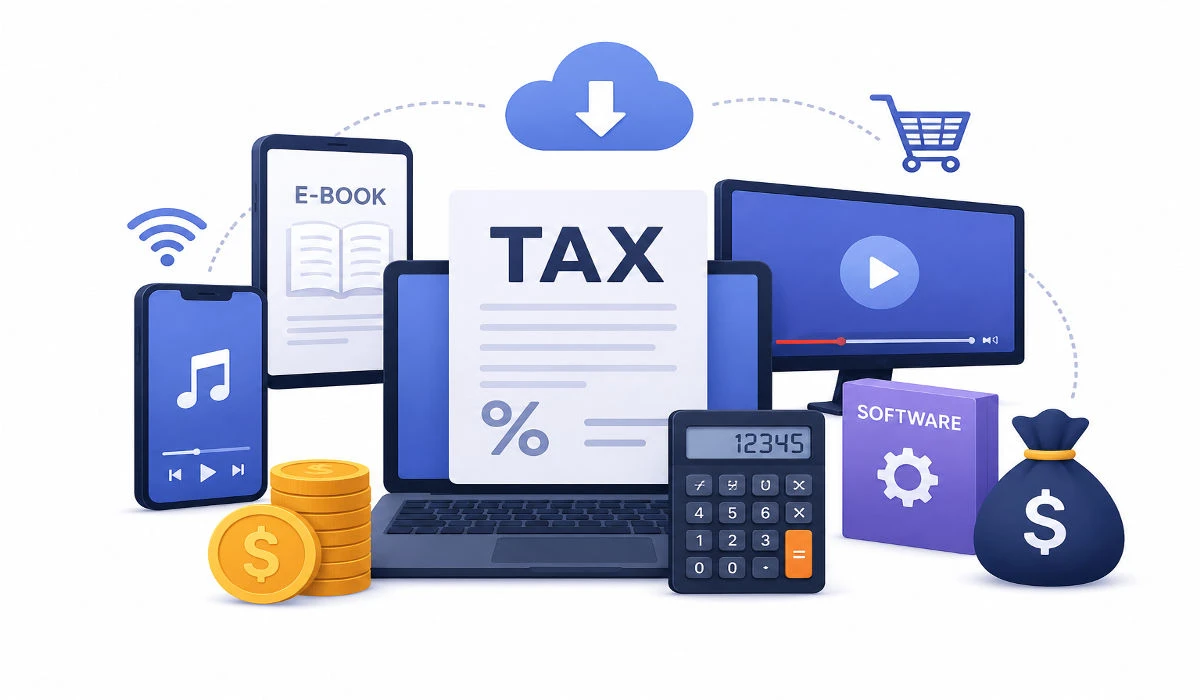
The modern e-commerce landscape offers an incredible shortcut to financial independence through the sale of virtual assets. Building a store that distributes downloadable items—such as automated database layouts, custom WordPress plug-ins, stock vector graphics, or premium educational e-books—enables entrepreneurs to generate automated, high-margin passive income without ever worrying about traditional physical retail challenges like shipping, manufacturing, or local stock storage.
However, because setting up an online store is incredibly easy, thousands of digital merchants rush to launch their platforms without checking global financial regulations. A massive, dangerous misconception in the e-commerce space is that because virtual downloads are intangible, they are exempt from standard retail taxation. In reality, fiscal authorities worldwide have systematically overhauled their tax frameworks over the past decade. Understanding how Taxes on Digital Product Sales apply to your virtual inventory is no longer optional; it is a critical administrative step to shield your business from devastating penalty audits, backend tax bills, and sudden merchant processor bans.
This definitive operational guide details the essential global tax rules, destination-based sourcing principles, and automated software configurations you must deploy in 2026 to keep your digital storefront fully protected.
The Critical Transition from Origin-Based to Destination-Based Taxation
Historically, business owners paid sales tax strictly based on where their company warehouse or physical office was legally registered. If you did not maintain a physical presence or “nexus” in a specific state or country, you did not have to collect taxes from buyers living in that territory.
However, the rapid growth of the virtual creator economy completely dismantled this old model. Today, global regulations governing Taxes on Digital Product Sales operate almost exclusively on a “destination-based” compliance framework. This structural change means that the tax rules of the buyer’s physical location apply to the transaction, regardless of where your website server is hosted or where your business entity is registered. If a customer in France or New York downloads a premium template from your site, your storefront is technically entering that local tax jurisdiction, triggering immediate compliance boundaries that you must legally navigate.
Navigating European Union VAT and UK Digital Tax Laws
The European Union was a pioneer in enforcing destination-based compliance rules for virtual assets through its cross-border VAT MOSS (Value Added Tax Mini One Stop Shop) framework, which has now transitioned into the streamlined One Stop Shop (OSS) system.
When studying the rules governing Taxes on Digital Product Sales within Europe and the United Kingdom, you must realize that there is no minimum revenue threshold for international sellers. The very first dollar, euro, or pound you generate from an EU or UK customer triggers a mandatory tax collection requirement. Your website must be technically configured to identify the buyer’s home country via their IP address or billing address, calculate the correct local VAT rate, collect that additional percentage during checkout, and later remit those accumulated funds to the respective European fiscal authorities on a quarterly basis.
Tax Compliance vs. High-Risk Financial Pitfalls
To ensure your digital product storefront remains completely insulated from international audit penalties and payment gateway freezes, use this analytical blueprint to review your financial habits:
Legally Protected Storefront Frameworks
- Automated Location Validation: Utilizing real-time geo-location matching at checkout to confirm a buyer’s true country or state tax zone.
- Merchant of Record Integration: Hosting product catalogs on specialized platforms (like Gumroad or Lemon Squeezy) that take full legal liability for global taxes.
- Itemized Tax Receipts: Providing automated, itemized billing invoices that clearly break down the base product cost and the collected tax amount separately.
High-Risk Storefront Pitfalls
- Flat-Rate Pricing Assumptions: Assuming a single blanket price covers global buyers without calculating region-specific digital sales taxes.
- Completely Ignoring Remote Nexus: Operating under the false assumption that international tax departments cannot monitor or penalize a remote digital storefront.
- Manual Tax Bookkeeping: Attempting to track, calculate, and file global quarterly digital taxes using basic spreadsheets without automated software.
Understanding United States Sales Tax and Economic Nexus Rules
The United States features one of the most complex frameworks for managing Taxes on Digital Product Sales due to its lack of a unified national sales tax system. Instead, sales taxes are governed independently by individual states, counties, and local municipalities.
Following the landmark Supreme Court decision in South Dakota v. Wayfair, individual states gained the legal authority to enforce “economic nexus” rules on remote online businesses. If your digital download brand reaches a specific financial threshold in a given state—typically $100,000 in gross revenue or 200 separate transactions within a calendar year—you are legally required to register with that state’s department of revenue. Once registered, you must collect local sales tax from every buyer inside that state, turning what seemed like a simple hobby store into a highly regulated enterprise.
Read More: Digital Product Refund Policies Explained
What Exactly Counts as a Taxable Digital Product?
A major source of confusion for online creators is determining whether their specific download files fall into taxable categories. Tax departments define digital goods as files that are stored, delivered, and used completely in an electronic format.
Standard items that are universally subject to Taxes on Digital Product Sales include:
- Downloadable Software Assets: Custom WordPress elements, SaaS integrations, mobile app source codes, and web scripts.
- Media and Graphic Kits: Stock video packages, audio stems, vector template bundles, and font packages.
- Digital Publications: Informative e-books, training manuals, downloadable PDF guides, and structured workbook systems.
- Membership Portals: Ongoing subscriptions that grant users continuous access to streaming content or premium file clouds.
How to Leverage a Merchant of Record (MoR) to Outsource Your Tax Liability
If tracking thousands of different tax rates across multiple continents sounds completely overwhelming, you are not alone. For independent creators and small digital agencies, managing Taxes on Digital Product Sales manually is a fast track to administrative burnout.
The smartest operational shortcut to eliminate this entire burden is routing your store workflows through a certified Merchant of Record (MoR). Platforms like Lemon Squeezy, Paddle, or Gumroad act as a legal middleman between your business and the consumer. When a customer buys a file, the MoR technically sells the product to the end-user, processes the transaction, handles the global tax calculation, collects the local VAT or sales tax, and files the returns under their own corporate umbrella. This allows you to focus purely on product creation while remaining 100% legally compliant.
Setting Up Automated Tax Engines on Independent Platforms
If you prefer to maintain absolute ownership over your checkout infrastructure by running an independent WooCommerce, Shopify, or custom-coded web framework, you must implement specialized tax automation engines.
To accurately handle Taxes on Digital Product Sales on a self-hosted platform, integrate enterprise-grade tax software plug-ins like Avalara, TaxJar, or Quaderno directly into your payment pipeline. These cloud-based engines communicate via APIs with your shopping cart in real-time. The moment a user fills out their billing details, the software pulls the exact, up-to-date tax rate for that specific zip code or province, adds it seamlessly to the checkout total, and logs the data into structured reports, making your end-of-year tax filing simple and stress-free.
Best Practices for Maintaining Bulletproof Financial Records
In the e-commerce space, compliance does not end once a quarter closes. If an international financial department ever conducts an administrative review of your store, you must possess well-organized transactional data.
To properly align your business with the global regulations surrounding Taxes on Digital Product Sales, your database must securely back up all customer location points. Financial regulators expect you to maintain at least two non-conflicting pieces of evidence proving where your customer lives—such as their verified billing country, their phone number country code, and their active checkout IP address token. Archive these securely alongside your invoice logs for at least five to seven years to ensure your digital enterprise can easily pass any surprise financial audit with absolute peace of mind.
FAQ
Q1. What happens if I completely ignore international taxes on my digital store?
Ans: Failing to comply can result in severe financial penalties, mounting interest on unpaid back-taxes, and the immediate freezing or permanent termination of your payment processing accounts (like Stripe or PayPal).
Q2. Are digital products taxed the exact same way in every single US state?
Ans: No. Some US states tax digital downloads at standard physical retail rates, some apply reduced specialized rates, and a few states do not tax virtual goods at all. You must track individual state nexus rules carefully.
Q3. If I use a Merchant of Record, do I still need to register for individual VAT numbers?
Ans: No. When utilizing a verified Merchant of Record, they assume all legal liability for the transaction, meaning they handle the registration, collection, and filing under their own corporate tax identification numbers.
Conclusion
Scaling a highly profitable digital product brand requires a smart balance of creative asset production, targeted search engine marketing, and bulletproof financial compliance. Taking short-sighted shortcuts with your store’s legal and tax framework might save you a bit of administrative time initially, but it leaves your entire e-commerce pipeline deeply vulnerable to catastrophic disruptions down the line.
By actively keeping up with the core requirements governing Taxes on Digital Product Sales—by identifying buyer locations dynamically, setting up automated tax calculation engines, tracking economic nexus boundaries, or utilizing an all-in-one Merchant of Record—you construct a safe, professional shield around your digital asset storefront. Treat your financial responsibilities with the professional diligence they deserve, secure your operational infrastructure, and watch your digital enterprise scale safely and sustainably for years to come.